What to Delegate to a Virtual Assistant (And What to Never Hand Over)
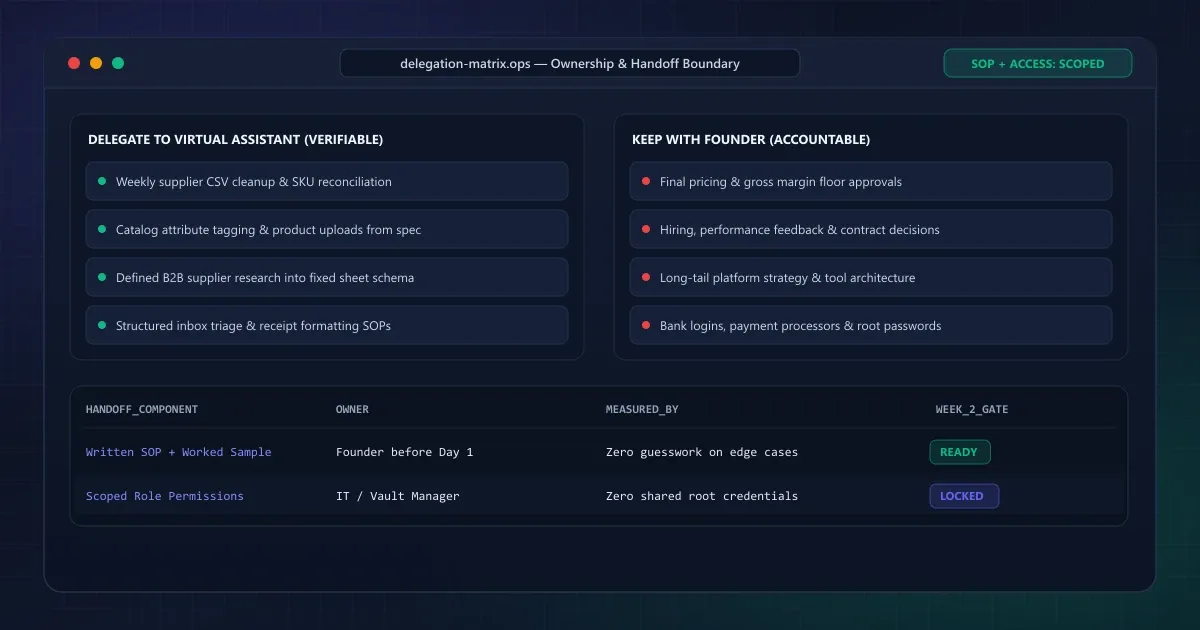
Most delegation failures are not caused by a bad assistant. They are caused by handing over a task that was never clearly defined, or by keeping something that should have gone first. Here is the line I draw.

Virtual Assistant & Data Entry Specialist
The worst delegation mistake I made early on was handing over a task I had not done myself in six months.
I described it from memory, left out two steps I had forgotten, and then spent a week fixing the output and quietly blaming the person doing it.
That was not their failure. It was a bad handoff.
Delegation works when three things are true: the task is genuinely repeatable, the output can be checked, and you can describe it well enough that someone else could do it without guessing. Everything below follows from that.
What belongs with an assistant
Structured data work
This is the classic and it is still the best first delegation. CSV cleanup, product uploads, catalog updates, spreadsheet maintenance, copying data between systems.
The output is verifiable, the source is unambiguous once you define it, and the work is measurable by row count and error rate.
The important qualifier is "once you define it." A blank instruction like "keep the inventory updated" fails.
"Every Monday, reconcile the supplier file against the master sheet, flag any SKU where quantity differs by more than five, and add the differences to the Discrepancies tab" works because there is nothing to interpret.
Repetitive administrative work
Inbox triage with clear rules, calendar management, travel booking within a stated budget, invoice data entry, document formatting, meeting notes from recordings. All of these are predictable, checkable, and low consequence if they go slightly wrong once.
The consequence test matters. If a wrong output costs you a five-minute fix, delegate freely. If a wrong output costs a customer relationship, put a review step in.
Research with a defined deliverable
"Find twenty suppliers of X in region Y with contact details and a link to their product page" is a good task. "Research the market" is not, because there is no finish line and no way to judge whether it is done.
Give the output a shape: a spreadsheet with specific columns, a specific row count, and a definition of what counts as a valid entry. Then the research becomes a checklist, and checklists are delegable.
First drafts where you own the final
Product descriptions from a specification, FAQ drafts from support emails, summary emails from call notes. The assistant produces the draft; you edit to your voice. This works when editing is faster than writing, which is true for anything over about four hundred words.
It fails when the assistant is asked to sound like you without enough samples. Give them three examples of your writing first.
What should stay with you
Pricing and commercial decisions
Gathering the data, yes. Setting the number, no. Anything that affects margin should pass through the person accountable for margin, and delegation here usually causes quietly bad outcomes rather than loud ones.
Anything involving a person's standing
Feedback, performance conversations, contract terminations. This is not about capability. It is that these conversations require authority that only comes with the owner of the relationship, and passing them along damages trust in a way that is difficult to repair.
Decisions with long tails
Tool selection, platform choice, brand direction, what to launch next. These have consequences for months and they need context that lives in your head, not in a document.
Legal and financial sign-off
Preparation, yes. Approval, no. And never credentials. An assistant should not hold the password to your bank, your domain registrar, or your payment processor.
If a task genuinely requires access, use a tool that grants limited permission for a brief period and logs the access, and rotate the credential afterwards.
The four tasks that always fail
These look delegable and are not, and every one of them has cost me something.
Tasks that depend on judgement you have not written down
"Choose which products to feature" requires taste built from customer conversations. The assistant has not had those conversations. They will produce something reasonable and not quite right, you will redo it, and the third time this happens both of you will be frustrated.
Either write the criteria down so it becomes a rule, or keep it.
Tasks whose success criteria only exist in your head
If you cannot describe what "done well" looks like in three sentences, you are not ready to delegate. That is not a limitation of the assistant; it is a description of your own unfinished thinking.
Tasks that require being trusted by your customers
A first reply to an angry customer, a refund decision on a disputed order, a negotiation. Customers can tell when they are talking to someone without authority, and it feels like being handled.
Tasks you will not have time to check
This one is subtle. If the work takes forty minutes and checking it takes thirty-five, the delegation saves almost nothing and adds risk. Either the check gets easier with a validation script, or the task is not ready to leave.
The handoff, which decides everything
A good handoff has five parts and takes about an hour to write the first time. It feels like overkill. It pays for itself within a week.
The five parts
Purpose. What this task achieves and why it matters. Without this, an assistant cannot make sensible choices when reality differs slightly from the instructions, which it always does.
Steps, numbered. Including the ones you think are obvious. Especially those, because the obvious steps are the ones you will forget to mention.
Examples. One good output and one bad output with a note on what makes the bad one bad. This is worth more than a paragraph of description.
The boundary. What to do when something unexpected appears. Usually: stop, note it, continue with the rest, and report the note. Without a stated boundary, people either invent a solution or abandon the batch, and both cost more than asking.
The definition of done. Row count, file name, where it goes, and how they will know it succeeded.
Write it as a document, not a message
Chat messages scroll away. A task that happens weekly needs a document that can be updated when reality changes. One page is enough.
The act of writing it will reveal at least two steps you had never articulated, and those are usually the steps that cause problems.
The first two weeks
Do not hand over everything on day one. Start with one task, review every output for the first three deliveries, then step back to spot checks.
During that period, note every time you correct something. Each correction is either a missing instruction, which goes in the document, or a genuine mistake, which is a conversation.
Sorting them correctly matters: treating a missing instruction as a mistake damages trust and teaches nobody anything.
By the end of two weeks, if you are still correcting the same thing twice, the document is wrong or the task is not a good fit. Both are worth identifying early rather than grinding through.
The minimum setup before you hand anything over
Delegation fails quietly when the assistant cannot get to the work. Before the first task, spend an hour on access, and spend it carefully because this is where security mistakes happen.
Shared drive with a clear structure. One folder for source files, one for output, one for archived work. If the assistant has to guess where something goes, they will guess differently each time.
A task tracker. Something as simple as a shared board with three columns: to do, doing, done. The value is not project management, it is that a written status removes the need for a daily check-in message.
Scoped passwords, never shared ones. Use a password manager with individual entries per person rather than pasting credentials into chat. When someone leaves, you revoke one entry instead of changing twelve passwords.
A single channel for questions. If questions arrive by email, WhatsApp, and a call, none of them get answered well and you lose the written record. One channel, and the answer stays searchable.
How to structure the arrangement
Hourly works when the work is variable and you cannot predict volume. It requires trust in timesheets and it rewards slowness, which is a real problem over months.
Per-task works well for defined, repeatable jobs with a clear finish line. Product uploads, catalog updates, invoice batches. You know the cost before it starts and so does the assistant, which removes a whole category of friction.
Retainer works when the relationship is long and the task list shifts. A fixed number of hours per week with a priority order for what fills them.
The risk is unused hours being resented by one side and overused by the other, so a monthly review of what was actually done keeps it honest.
For a first delegation, I suggest per-task. It forces you to define the deliverable, which is the skill you are practising, and it makes the value easy to judge at the end.
Measuring whether it is working
Three numbers. Time you spend on the task now versus before. Error rate in the output. How often you have to re-explain something.
If time is down but the error rate is up, you have moved work rather than removed it. If both are down but you are re-explaining every week, the handoff is incomplete and will keep costing you attention.
The line, in one paragraph
Delegate anything repeatable, checkable, and describable. Keep anything requiring judgement you have not written down, authority you cannot transfer, or sign-off you are accountable for.
And write the handoff down. Most of what people call a delegation problem is actually a documentation problem wearing a different hat.
Security standards and VA guides
Never share raw root passwords; follow OWASP least-privilege access principles and scoped organization sharing in tools like Bitwarden Organizations.
Before bringing someone on, read our two-week client onboarding playbook and guide to managing a specialized data VA.
Frequently Asked Questions
Common operational inquiries related to What to Delegate to a Virtual Assistant (And What to Never Hand Over)
Ready to Delegate Catalog, Spreadsheet & Admin Workflows Safely?
Onboard a specialist VA who writes clean SOPs, scopes access properly, and tracks hours transparently. Book a free 15-minute discovery call to start.

Written by Wp Hossain (Mikail Hossain)
Senior Catalog & E-Commerce Specialist with 7+ years handling multi-thousand-SKU WooCommerce, Shopify, and supplier CSV migrations (4.9/5 across 82 Fiverr reviews).