Onboarding a New Freelance Client: The First Two Weeks Decide the Project
Projects rarely fail in the middle. They fail in week one, when nobody agreed what done looks like. Here is the onboarding sequence that has kept my projects from drifting, including the awkward questions worth asking early.

Virtual Assistant & Data Entry Specialist
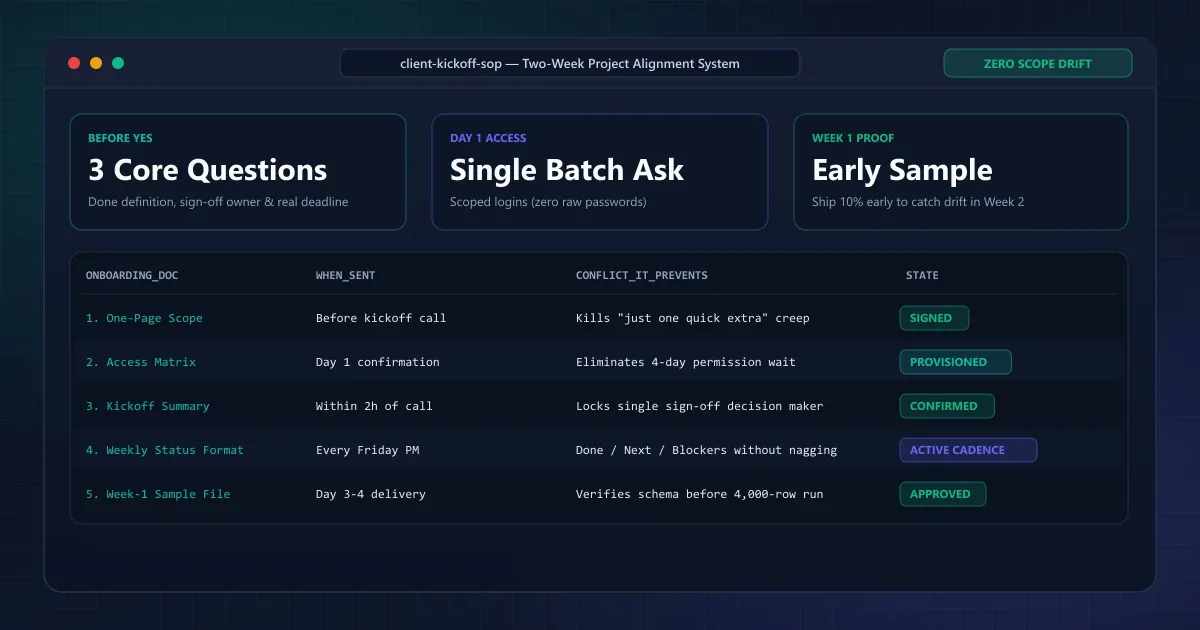
Almost every project that went badly for me went badly in a way that was visible in week one. The client was vague about who could approve work.
Or the data I needed lived with someone who was on holiday for ten days. Or "a few product descriptions" turned out to mean four hundred.
None of those were surprises I could not have seen. I just did not ask early enough, because asking felt like doubting the client.
I ask now. These are the questions and the documents, in the order I do them.
Before you say yes
Onboarding begins before you accept the project, with three questions that decide whether the project is a good fit at all.
What does done look like, in one sentence?
If the client cannot answer this, the project is not ready and neither are you. It is not a red flag about them personally; it usually means they have not had to articulate it yet. Asking gives them the chance to.
If the answer is a shape you can deliver, good. If the answer is a feeling, the project needs a discovery step first, and that should be its own paid phase rather than absorbed into delivery.
Who signs off, and who else will give feedback?
These are usually different people and mismatching them is the classic source of infinite revision loops. You deliver to the person who signs off. Everyone else's feedback is optional input.
Ask directly: "If [name] says it is good, is it approved?" An explicit yes here saves weeks.
What happens if the deadline slips a week?
The answer tells you whether the deadline is real. If a week late breaks a launch, you need to know before you plan. If it is a soft target, you also need to know, because it changes how you sequence the work.
Access you need before day one
Waiting for access is the most common cause of a slow first week. It is a piece of friction that costs nothing to prevent and feels embarrassing to chase later, so chase it immediately.
| What | Who usually has it | Lead time |
|---|---|---|
| Read access to source data | Client or their ops person | Same day |
| Write access to the working file | Whoever owns the file | 1 to 2 days |
| Platform logins, scoped | Client, often requires approval | 2 to 5 days |
| A contact for technical questions | Client | Same day if asked early |
Ask for all of it on the day the project is confirmed, in one message, with a clear statement of what each is for.
A single consolidated request gets answered faster than four separate ones, and it lets the client delegate the whole thing to one person.
Never ask for a password directly. Ask for access, and let them add you to the tool. If a tool has no way to add a user, that is a conversation about the tool, not a reason to share credentials.
The kickoff conversation
Thirty minutes, structured, with notes that get sent afterwards. Four sections.
Context, not requirements
Ask why this work matters and what happens after it lands. This is not small talk. Knowing that a catalogue cleanup is happening because a store is migrating in March changes how you prioritise, and knowing that nothing depends on it changes it again.
Constraints
What is fixed and what is flexible. Fixed might be a format, a platform, a brand rule, or a date. Knowing which parts are non-negotiable prevents you from proposing something elegant that cannot be used.
Examples of good and bad
Ask for one existing thing they consider good and one they consider bad, with a reason. This single question transfers more implicit knowledge than an hour of description, and it usually surfaces a constraint nobody thought to mention.
How review will work
When you send work, who looks at it, and how long they have to respond. Agree this explicitly. An unstated review time is how a project stalls with nobody at fault.
My default: work goes out on a specific day, feedback due within two working days, silence past that counts as approval.
Every client agrees to that, and it has never been a problem, because the point is that the expectation exists rather than the strictness of it.
The four documents that prevent arguments
1. A scope statement
One page. What is included, what is not, and what happens when something outside the scope is requested. The "what is not" section matters more than the "what is" section, because that is the one people quote later.
Be concrete. "Up to 500 product records" is a scope. "Product data cleanup" is a wish.
2. A timeline with dependencies
Not just your dates, but what you need from the client and when. If the client's input is late, the dates move, and that should be written down before it happens rather than negotiated after.
3. A delivery format definition
What the file will be called, what format, where it goes, and what counts as complete. This eliminates the small annoyances that accumulate into a difficult relationship, like a file delivered in a format the client cannot open on their machine.
4. A change process
How a new request is handled. Not "no", just "here is how it is handled." A short paragraph: new requests go in writing, are estimated separately, and either replace existing scope or extend the timeline.
Everybody agrees to this in week one and nobody remembers it in week four, which is why it is written down.
What the first week should look like
Day one: all access requested, scope document sent. Day two: access confirmed, source data in hand. Day three: first sample of work delivered, even if small.
That third day matters more than it sounds.
A small piece of real work in the first week does three things: it proves the access and the workflow, it gives the client something concrete to react to, and it establishes the cadence of delivery before any big deliverable is at stake.
I aim for a sample on day three even when there is nothing meaningful to show, and I say explicitly that it is a sample to test the format. Clients respond to something concrete far better than to a plan.
The questions that feel awkward and are worth asking
"What has gone wrong with a previous freelancer?" Direct and slightly uncomfortable. The answer tells you what the client is anxious about and what they will be watching for. Two minutes of discomfort now prevents a month of guessing.
"Is there anything about this project you are worried about?" Opens the door to the thing they have not said. Often it is a budget concern, sometimes a previous failure, occasionally a deadline nobody else knows about.
"How would you like to hear about problems?" Because at some point there will be one. Whether they want it immediately or batched in a weekly note changes how you work, and asking in advance makes the first problem message much easier to send.
Onboarding signals worth paying attention to
Refusal to define scope in writing. Occasionally legitimate urgency, more often a sign that scope will expand freely. Ask once more, politely, and note what happens.
More than two approvers. Manageable, but it means every round of feedback takes longer. Plan for more review cycles than you think.
No access after a week. Either the client does not have it either, or the project is not actually a priority. Both are information.
Pressure to start before scope is agreed. Sometimes legitimate, and then the honest response is a time-boxed discovery rather than open-ended delivery.
Setting the communication rhythm
Most client friction is not disagreement, it is uncertainty. The client does not know whether work is happening, and the freelancer does not know whether the client is waiting on something. A rhythm removes both.
Mine is simple. A short written update every Friday, four lines: what moved this week, what is next, what I need from them, and anything at risk. It takes eight minutes and it eliminates the "just checking in" message entirely, because they already know.
It also creates a written record. When a scope question arises in week six, the Friday updates from weeks one through five answer it without anyone having to remember.
Keep it to one channel. If updates go out by email and questions come back by chat and decisions get made on a call, none of it is searchable and half of it is forgotten.
One channel for updates, and calls are summarised into that channel afterwards.
Two weeks is the whole game
If a project is going to go wrong, the shape of the problem is almost always visible by week two. Access delays, approval ambiguity, scope that will not sit still, or feedback that arrives in scattered messages instead of a collected list.
None of those are fatal. All of them are much easier to address in week two than in week ten.
In week two you are still establishing how you work together, so the conversation stays about the process rather than anyone's performance.
That is the entire argument for spending real effort on onboarding. It is not admin. It is the cheapest point at which to fix a project.
Access hygiene and related client guides
Protect client accounts with scoped access control practices and keep milestone billing structured cleanly using tools like Stripe Invoicing milestones.
Pair your kickoff routine with our transparent billable hours system and task delegation checklist.
Frequently Asked Questions
Common operational inquiries related to Onboarding a New Freelance Client: The First Two Weeks Decide the Project
Ready to Delegate Catalog, Spreadsheet & Admin Workflows Safely?
Onboard a specialist VA who writes clean SOPs, scopes access properly, and tracks hours transparently. Book a free 15-minute discovery call to start.

Written by Wp Hossain (Mikail Hossain)
Senior Catalog & E-Commerce Specialist with 7+ years handling multi-thousand-SKU WooCommerce, Shopify, and supplier CSV migrations (4.9/5 across 82 Fiverr reviews).